<span class="txt-orange">World’s first sustainable Rice Partnership</span> in the running for MacArthur Foundation US$100 million grant
<span class="p1">There is a paradox where rice is vital to food security yet simultaneously has the largest carbon footprint of all food crops. By 2050, rice production will need to almost double to meet the population demand, which under current conditions, will require additional land equivalent to the size of Chile, and add 300 billion kgs of CO2 equivalent emissions.</span>
<span class="p1">The Sustainable Rice Platform, or SRP, first conceived by the United Nations and the International Rice Research Institute, is addressing the “rice paradox” through a framework for increasing production in a sustainable way. The multi-stakeholder alliance comprises 100 global public, private and civil society organisations, and promotes resource-use efficiency and climate change resilience, both on-farm and throughout the rice value chain.</span>
<span class="p1">The SRP principles were first put to the test in a pilot project implemented by Olam, in partnership with the Thai Rice Department and German development agency <a href="https://www.giz.de/en/html/index.html">Deutsche Gesellschaft für Internationale Zusammenarbeit (GIZ) GmbH</a>. Starting with 71 farmers in 2016, the project in Thailand has trained over 6,000 farmers to date on climate-smart practices and has produced the world’s first fully-verified sustainable rice.</span>
<span class="p1">Today, SRP projects have reached 500,000 rice farmers across Asia, Africa, Europe and the Americas, with notable results including a 10% increase in farmers’ income, 20% savings in water use and 50% reductions in greenhouse gas emissions. The goal is to reach 1 million farmers by 2023.</span>
<span class="p1">The programme has subsequently been designated as one of the Top 100, in the MacArthur Foundation’s <a href="https://www.macfound.org/programs/100change/">100&Change</a> competition, in recognition of its “real and measurable progress in solving a critical problem of our time”.</span>
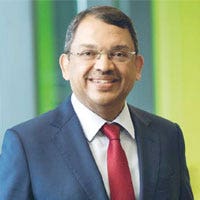
<h5><span class="p1"><b><br>Paul Nicholson, Vice President, Rice Research and Sustainability at Olam and SRP Executive Board member added:</b></span></h5>
<span class="p1">“We also recognise that to truly transform global rice markets, the sustainable rice produced will need take-up. This is where we look down the supply chain to retailers, who can use SRP as a procurement standard and engage with banks and insurers to incentivise farmers who produce rice sustainably. They can lead this change and in turn, help grow, as well as meet, the demand for sustainable rice.”</span>
<h5><span class="p1"><b><br>Matthias Bickel, Chairperson SRP Board, Director Deutsche Gesellschaft für Internationale Zusammenarbeit (GIZ) GmbH:</b></span></h5>
<span class="p1">“Mobilizing investments for small-scale rice farming communities to shift toward sustainable rice production is essential for our planet’s survival and to preserve the backbone of global food supply. Engaging these communities is key to combatting climate change and to preserving natural resources like fresh water. It’s high time to overcome the underinvestment in small-scale farming and to tackle farmers as agripreneurs in a market-driven environment.”</span>
<h5><span class="p1"><b>Wyn Ellis, Executive Director, Sustainable Rice Platform continued:</b></span></h5>
<span class="p1">“Transforming the global rice sector to meet our future food needs sustainably requires broad-scale collaboration among business and society. While the SRP Standard and Indicators for Sustainable Rice Cultivation provide proven technological solutions for rice smallholders, 100&Change now offers a unique opportunity to work with Olam, GIZ and SRP stakeholders to scale up adoption of climate-smart, sustainable best practices among resource-poor smallholders and contribute to a range of SDGs.”</span>
<span class="p1" style = "text-align: center; display:block" >---------</span>
<h5><span class="p1"><i><b>Notes to editors:</b></i></span></h5>
<span class="p1">i The shortlist, or Top 100 represents the top 21 percent of competition submissions. View the <a href="https://solutions.leverforchange.org/explore-solutions/?page=9#proposal-search-facets-and-results">Top 100</a>. The final award recipient will be announced in Autumn 2020. Read more <a href="https://www.macfound.org/programs/100change/strategy/">About the competition</a></span>
<span class="p1">ii Sustainable rice farming techniques under the SRP Standard include land levelling, better inputs such as quality seeds and tools, correct soil management and fertiliser application, and biomass removal. </span>