Untying Gender Constraints, <span class="txt-orange">the Cooperative Way</span>
<span class="p1">Elegantly clad in a zebra-printed cotton dress, Outtara Aminata’s joyful demeanour belies a life most would consider tough, but which she has taken in her stride. Her story could be an inspiration for many seeking a better life for their families.</span>
<span class="p1">The 37-year old lives in a remote village of 500 people in the north of Côte d'Ivoire. Up at 5am, she used to only do the unremitting back-breaking work of maintaining a household. Now Aminita is also a smallholder cotton farmer. She took on her second, and only paying “job”, three years ago and has never been happier.</span>
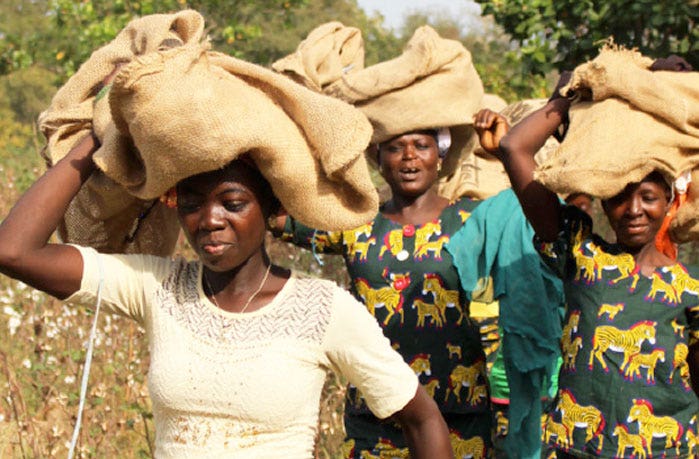
<span class="p1">“<i>Everything is different! My life is completely different. My children can now go to school because I can pay school fees. I didn’t even have one good dress before</i>,” said Aminata, gesturing to the zebra print dress she and others in the Benkadi Women’s Association wear in her village of Tchewelevogo.</span>
<span class="p1">She is one of the 227 women farmers who have been recruited into cooperatives by Olam’s International’s cotton arm, SECO (Société d'Exploitation Cotonnière Olam) and are now part of a 17,769-strong network of smallholder farmers across Côte d'Ivoire that SECO works with to buy cotton from and improve their livelihoods in the process.</span>
<span class="p1">Integrating Benkadi and the other Women’s Associations into cooperatives, meant that - for the first time - these women had access to financial support to embark on an income-generating activity of their choice, cotton farming being one. And so the first independent female farmers in Côte d'Ivoire emerged, with the creation of communal plots of land to share amongst the group members.</span>
<span class="p1">SECO’s outreach programme through the co-operatives runs the gamut – from a continual farmers’ training programme to building infrastructure such as water pumps, health clinics and schools. The training itself goes beyond farming practices and includes social messages such as the importance of children going to school – rather than becoming child labourers.</span>
<span class="p1">The 37-year old lives in a remote village of 500 people in the north of Côte d'Ivoire. Up at 5am, she used to only do the unremitting back-breaking work of maintaining a household. Now Aminita is also a smallholder cotton farmer. She took on her second, and only paying “job”, three years ago and has never been happier.</span>
<span class="p1">“<i>Everything is different! My life is completely different. My children can now go to school because I can pay school fees. I didn’t even have one good dress before</i>,” said Aminata, gesturing to the zebra print dress she and others in the Benkadi Women’s Association wear in her village of Tchewelevogo.</span>
<span class="p1">She is one of the 227 women farmers who have been recruited into cooperatives by Olam’s International’s cotton arm, SECO (Société d'Exploitation Cotonnière Olam) and are now part of a 17,769-strong network of smallholder farmers across Côte d'Ivoire that SECO works with to buy cotton from and improve their livelihoods in the process.</span>
<span class="p1">Integrating Benkadi and the other Women’s Associations into cooperatives, meant that - for the first time - these women had access to financial support to embark on an income-generating activity of their choice, cotton farming being one. And so the first independent female farmers in Côte d'Ivoire emerged, with the creation of communal plots of land to share amongst the group members.</span>
<span class="p1">SECO’s outreach programme through the co-operatives runs the gamut – from a continual farmers’ training programme to building infrastructure such as water pumps, health clinics and schools. The training itself goes beyond farming practices and includes social messages such as the importance of children going to school – rather than becoming child labourers.</span>
oga-container--news-detail-container
<span class="p1">The training is done on-the-ground by a contingent of 180 field staff covering 804 villages, who go from village to village to conduct the training. They are aided by a 28-person agricultural unit with agronomists, and other staff who run model farms and social projects.</span>
<span class="p1">After Aminata completed one such round of training in 2015, the community allotted her a 1.5ha plot of land to do cash-crop farming for the first time.</span>
<span class="p1">After Aminata completed one such round of training in 2015, the community allotted her a 1.5ha plot of land to do cash-crop farming for the first time.</span>
image
articleImg
top
landscape
oga-container--inner
We learnt everything on farming that we hadn’t known before - how to sow cotton, how using fertiliser is good for all crops, including our food crops, how to pick cotton and how to tell good and bad cotton.
Aminata
- Benkadi Women’s Association wear in her village of Tchewelevogo.
<span class="p1">Of course, like other women in the community, she has always tended to food crops like maize and yams, but that was entirely on a subsistence basis. Before this, any money, including school fees for her children, had to come from her husband. If crops didn’t do well that season, it meant the family had to do with less or none.</span>
<span class="p1">Not that the men have an easy time of it. They, too, work long hours tending farms with multiple cash crops including cotton. They, too, are part of SECO’s cooperative outreach programme, which has grown from 3,000 in 2008 to 17,769 in 2018, and continues to expand this year.</span>
<span class="p1">Building on her successes, Aminata has now also taken on the responsibility of helping others. She is the Secretary the Women’s Association and was pivotal in its transformation from a platform, to organising big parties for the village into becoming a conduit for SECO to conduct farmer training.</span>
<span class="p1">In fact, last harvest season, the women farmers averaged 1.6 tonnes/ha for their cotton while the men got an average yield of 1.1 tonnes/ha, which is still above average.</span>
<span class="p1"> “<i>The men come to us for advice now on how to improve their farming</i>”, Aminata says proudly.</span>
<span class="p1">Not that the men have an easy time of it. They, too, work long hours tending farms with multiple cash crops including cotton. They, too, are part of SECO’s cooperative outreach programme, which has grown from 3,000 in 2008 to 17,769 in 2018, and continues to expand this year.</span>
<span class="p1">Building on her successes, Aminata has now also taken on the responsibility of helping others. She is the Secretary the Women’s Association and was pivotal in its transformation from a platform, to organising big parties for the village into becoming a conduit for SECO to conduct farmer training.</span>
<span class="p1">In fact, last harvest season, the women farmers averaged 1.6 tonnes/ha for their cotton while the men got an average yield of 1.1 tonnes/ha, which is still above average.</span>
<span class="p1"> “<i>The men come to us for advice now on how to improve their farming</i>”, Aminata says proudly.</span>
oga-container--news-detail-container